Track your eGFR over time — catch decline early
What is eGFR?
eGFR (estimated Glomerular Filtration Rate) measures how well your kidneys filter waste from your blood, expressed in mL/min/1.73m². Normal is above 90. CKD stages run from 1 (≥90) through 5 (<15). A single result tells you today's stage; a trend over 12–24 months reveals whether function is stable or declining. (KDIGO 2024)
Kidney decline is often silent. A single eGFR of 62 looks unremarkable on its own. A drop from 78 to 62 over two years is a different story entirely — and Kinmetry makes that story visible.
No credit card required · Free plan · GDPR compliant
1 in 7
US adults has chronic kidney disease — ~90% don't know it (CDC / NIDDK)
>5 mL/yr
eGFR decline KDIGO 2024 defines as rapid progression — warrants urgent evaluation
20–40%
of people with diabetes develop kidney involvement, often without symptoms (NIDDK)
A single result is just a snapshot
Kidney decline is a trend — and trends only become visible when the data is in one place

CKD stage 2 or 3 — is the decline accelerating?
Your nephrologist checks eGFR every three to six months. Having every result plotted in one place makes it immediately clear whether the gradual decline is staying gradual — or beginning to steepen.

Type 2 diabetes with no kidney symptoms
Diabetic kidney disease often develops silently for years before any symptoms appear. Approximately 20–40% of people with diabetes develop kidney involvement (NIDDK). Tracking eGFR makes that silent trend visible.

Helping an elderly parent with multiple providers
Your parent sees a GP, a cardiologist, and a nephrologist — each running their own tests across different hospitals. The eGFR results exist in three separate systems. Kinmetry puts them all on one timeline.
How Kinmetry tracks eGFR
Upload reports from any lab
PDF or photo, Chinese or English, from any hospital or country. Kinmetry reads them all.
eGFR and kidney markers extracted
eGFR, creatinine, BUN, and urine albumin identified automatically from each report — no manual entry.
Decline becomes visible over time
A drop from 82 to 71 over three years only becomes a story when all the data points are connected.
eGFR alongside every related kidney marker
eGFR tells one part of the story. Creatinine, uric acid, and urine albumin fill in the rest — Kinmetry tracks all of them on the same timeline.
200+ biomarkers tracked
eGFR, creatinine, BUN, uric acid, albumin, electrolytes — one timeline for the full picture.
Out-of-range flags
Values outside the reference range on your report are highlighted across every chart.
Any language, any lab
Chinese (肾小球滤过率 / 肌酐), Japanese, Korean, English — extracted and normalized.
GDPR-compliant privacy
Health data treated as Article 9 special category. Never sold. Delete everything anytime.

Your kidney health data stays private
Kinmetry treats all health data as GDPR Article 9 special category data. AI processing uses providers with Data Processing Agreements. We never sell data, never train AI on your records, and you can export or permanently delete everything at any time.
Common questions about eGFR tracking
What is a normal eGFR level?
An eGFR above 90 mL/min/1.73m² is considered normal kidney function (CKD stage 1 if kidney damage markers are present). CKD stage 2 is eGFR 60–89; stage 3a is 45–59; stage 3b is 30–44; stage 4 is 15–29; stage 5 (kidney failure) is below 15. However, a single eGFR reading can fluctuate with hydration, diet, and illness — the KDIGO guidelines emphasize that CKD classification requires two or more readings at least 90 days apart.
How fast should eGFR decline with age?
A gradual age-related decline of about 0.7–1.0 mL/min/1.73m² per year is considered normal after age 40. The KDIGO 2024 guidelines classify a decline greater than 5 mL/min/1.73m² per year as rapid progression, which warrants investigation even if the absolute eGFR remains in a moderate range. This is exactly why tracking trend over time — not just checking today's number — matters.
How does Kinmetry track eGFR over time?
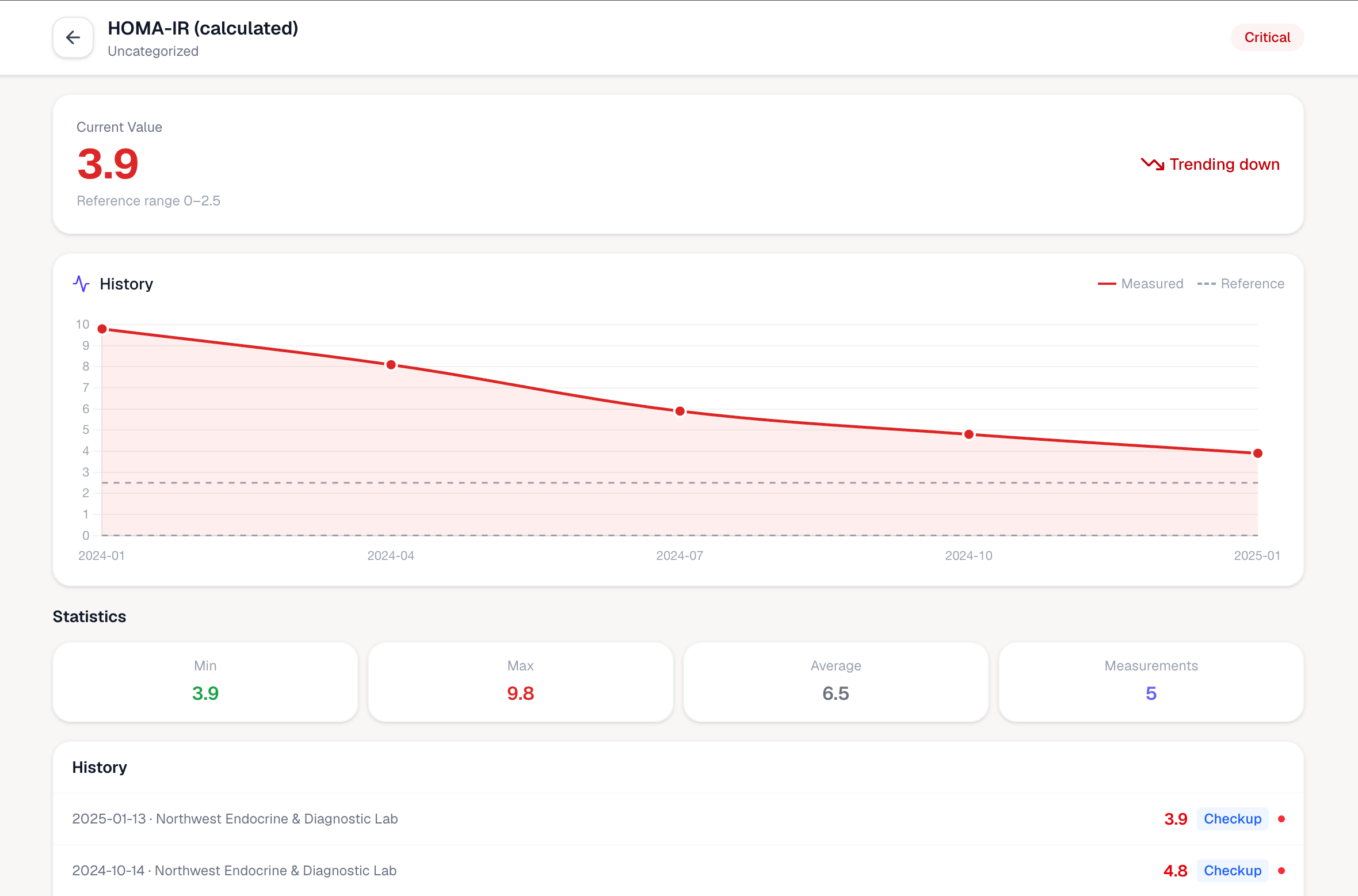
Kinmetry extracts your eGFR value, creatinine level, test date, and reference range from each uploaded lab report automatically. Results across all your reports are plotted as a continuous trend chart — so a decline from 82 to 71 over three years becomes visible as a trend line, not just two disconnected numbers.
Can Kinmetry track eGFR alongside creatinine and urine markers?
Yes. Kinmetry extracts all kidney-related markers from your reports — eGFR, serum creatinine, BUN (blood urea nitrogen), uric acid, and urine albumin-to-creatinine ratio where present. Each marker gets its own trend chart, and you can view them alongside each other to get the full picture of kidney health over time.
My parent's kidney reports are from a Chinese hospital. Can Kinmetry read them?
Yes. Kinmetry extracts eGFR and related kidney markers from Chinese-language reports — eGFR appears as 肾小球滤过率 or estimated GFR, and creatinine appears as 肌酐. The extracted values are normalized to international units (mL/min/1.73m²) and plotted on the same chart as any English-language results.
References
- 1.KDIGO — Clinical Practice Guideline for Chronic Kidney Disease 2024
- 2.NIDDK — Chronic Kidney Disease
- 3.National Kidney Foundation — eGFR
- 4.NIH MedlinePlus — Creatinine and eGFR
- 5.CDC — Chronic Kidney Disease Basics
This page is for informational purposes only and does not constitute medical advice. Always consult a qualified healthcare professional regarding your individual health situation.
Related: Blood Test Trend Tracker · Track HbA1c Over Time · Cholesterol Trend Tracker
Start tracking your eGFR trend today
Free plan · Upload your first report now · Works with reports from any lab, any country
Create free account